
How to Label Moving Boxes: Numbers, Colors and QR Codes Compared
Every move produces the same scene about three days in. Forty boxes in the garage, all the same brown, all with a word on top in marker, and the thing you need is the coffee maker. You know it is in a box that says KITCHEN. Eleven boxes say KITCHEN.
Labeling is the cheapest part of a move and the part that decides how the first week goes. There are three systems that actually work, and they stack. Here is how each one holds up, what to write on every box no matter which you pick, and where the label has to go.
Rule zero: the label goes on the side
Before any system, one rule. Boxes get stacked, so anything written on top vanishes the moment the second box lands on it. Put your label on the side, in the upper third where it is visible on a stack, and put it on two adjacent sides so the box can face either way against a wall. It costs one extra label and saves you from spinning boxes on moving night.
System 1: room and number
The baseline. Every box gets a destination room and a running number: Kitchen 1, Kitchen 2, Bedroom 1. Keep a list, on paper or in your notes app, of what each number holds.
This works because it makes every box unique. Eleven boxes that say KITCHEN are eleven guesses; Kitchen 7 is one box, and if Kitchen 7 is not on the truck you know it before the truck leaves. The number is also the only reliable way to check that everything arrived.
Where it strains is the list. Writing "Kitchen 7: blender, toaster, coffee maker, filters, the good mugs" for 80 boxes is real work, and by box 50 most people are writing "misc." Then the list says misc and you are back to opening boxes.
Do this even if you do nothing else. The number costs three seconds a box.
System 2: color by room
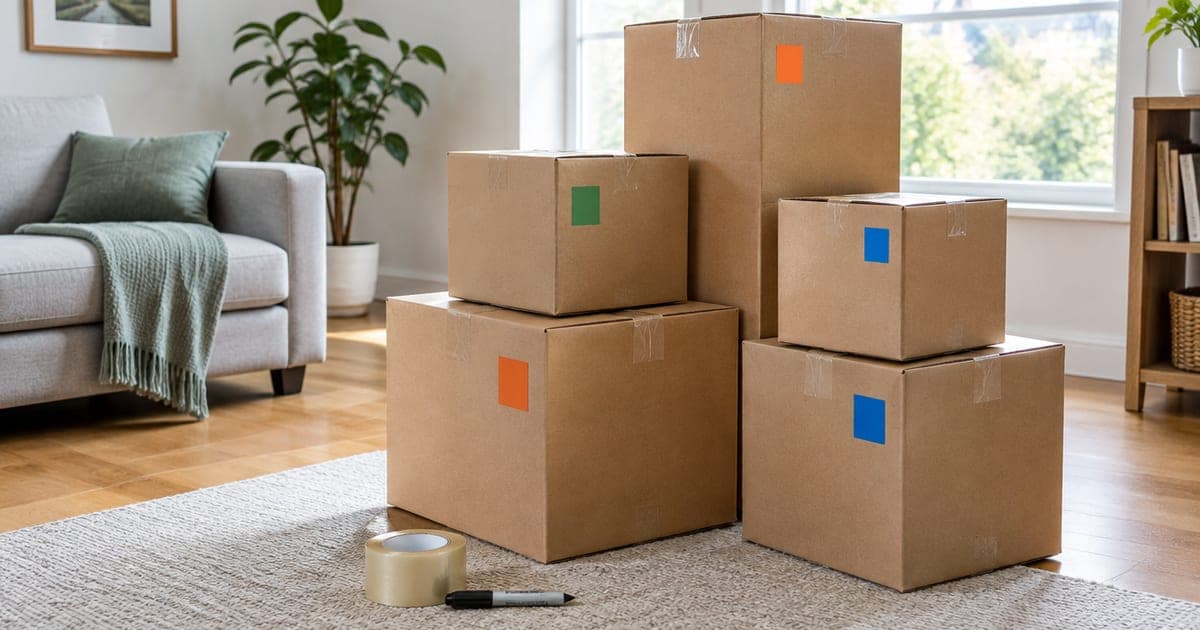
One color per room. Kitchen boxes get orange labels, bedroom boxes get purple, and so on. Anyone carrying a box can see where it goes from across the room without reading a word, which is exactly what you want from movers, friends, and a teenager who has been asked to help.
The mistake is colored tape. Tape is fine on the roll and useless on the box, because it looks like packing tape from four feet away and it does not carry a number. Use colored labels or colored stickers big enough to read at a distance, and pair each color with a room name written on it, since nobody remembers by day two whether green was living room or garage.
Pre-printed kits do the pairing for you. The SnapFind Moving Kit is 108 labels across seven rooms, each already carrying a room name and a number, so Kitchen 7 exists before you pick up a marker. Two of the seven rooms are write-ins for a nursery, a workshop, or the storage unit.
Color solves the carrying problem. It does not solve the coffee maker problem, because the color tells you the room, not the box.
System 3: a QR code on every box
This is the one that answers "which box has the coffee maker" without opening anything.
The label carries a code instead of a list. When you seal a box, you scan the code and take one photo of what is inside. The photo is the inventory. On the other end, you scan the box and see the photo, or you skip the scanning entirely and search "coffee maker" on your phone and it tells you Kitchen 7.
With SnapFind's Moving mode, the AI names the items in the photo, so a box comes back as "French press, kettle, mugs, tea tins" without typing. Boxes are grouped by room with a packed count, and the inventory stays useful after the move: the box that went straight to the basement is still searchable in March.
Two honest limits. It needs a phone and the app, and it adds about 20 seconds a box for the photo. On an 80-box move that is half an hour, spent once, against every box you would otherwise open twice.
The three systems, side by side
| System | Time per box | What it tells you at the new house | Where it fails |
|---|---|---|---|
| Room and number | 3 seconds | This is a unique box and it arrived | Contents live in a list nobody finished writing |
| Color by room | 3 seconds | Which room it goes to, from across the truck | Cannot tell one kitchen box from another |
| QR code + photo | 20 seconds | Exactly what is inside, searchable | Needs a phone and a minute of setup |
They stack. A kit label with a room, a color, a number and a code is all three systems on one sticker, and that is the combination that holds up on unpacking night.
What to write on every box, whichever system you use
Four fields, always in the same spot:
- Destination room in the new house, not the old one. "Office" means the room that will be the office.
- Box number within that room.
- Priority tier. A 1 means open tonight (sheets, the kettle, chargers, the toilet paper). A 2 means this week. A 3 means whenever. Unpacking by tier instead of by whichever box is closest is the single biggest difference between a livable house on night one and a month of living out of boxes.
- Handling notes. Fragile, this side up, heavy. Written large.
Contents go on the label only when the list is short enough to stay legible. Otherwise they belong in a photo.
Where each system quietly breaks
The garage and storage boxes. Boxes that are not being unpacked, the ones headed for the basement or a storage unit, are the ones you will search for a year from now. Numbers and colors do nothing for them. These are the boxes to photograph, and they are also the ones worth a permanent QR code instead of a peel-off moving label.
Repacked boxes. A box gets opened on night one for the kettle and resealed with the kettle missing. The written list is now wrong. A photo inventory is wrong too, until you take one more photo, which is a ten-second fix instead of a rewrite.
Helpers. Any system that lives in your head fails the moment someone else carries a box. Colors fix the carrying. A shared inventory fixes the "where did you put the box with the router" text at 9 p.m., because the person asking can search for it themselves.
The five-minute setup
You do not need to plan this. Buy or print labels before you buy boxes, keep them and a marker in the room you are packing, and label each box before it is sealed, when you can still see what is in it. Photograph the contents in the same motion if you are using codes. Number in the order you pack, not in some ideal order, and keep the tier-1 boxes together so they load last and unload first.
That is the whole system. Room, number, tier, and a photo if you want to never open the wrong box again.
Frequently asked questions
Should I number my moving boxes or color code them?
Both, if you can. A number makes each box unique so you can tell whether all 43 arrived, and a color lets anyone carrying a box see which room it goes to from across the truck. Numbers alone leave helpers reading tiny handwriting; colors alone cannot tell you that Kitchen box 7 is missing.
What should I write on a moving box label?
Four things: the destination room, a box number, a priority (1 for open-tonight, 2 for this-week, 3 for whenever), and any handling note such as fragile or this side up. Contents go on the label only if the list is short; otherwise keep contents in a photo or an inventory so the label stays readable.
Where should the label go on a moving box?
On two adjacent sides, in the upper third, never on the top. Boxes get stacked, so a top label disappears under the next box, and a single side label is a coin flip when the box is turned against a wall.
How many labels do I need for a move?
Plan on two labels per box and count high. A two-bedroom apartment is typically 40 to 60 boxes; a three-bedroom house is often 80 to 120. The SnapFind Moving Kit has 108 labels across seven rooms, which covers most houses with some left over.
Do QR code labels on moving boxes need an app?
Yes, that is the point of them. The code itself holds nothing; it opens the record for that box, where the photo of the contents lives. The SnapFind app is free to use with the kit labels, and the first scan of a kit label switches on Moving mode.
Packing this month? Download SnapFind, photograph the first box you seal, and search for it from the other end of the house. The rest of the move goes the same way.